Birthstone Jewellery 2026: Complete UK Guide by Month

Birthstone Jewellery UK
by Month & Meaning
Twelve stones. Twelve stories. A practical guide to choosing, wearing and gifting birthstone jewellery that actually means something.
Where Birthstones
Actually Come From
Birthstone jewellery sits at a rare intersection: genuinely fashionable and genuinely personal. A single stone on a chain can hold a birth month, a child's identity, a memory you refuse to let fade.
There is something quietly powerful about wearing a stone that belongs to you. Not because of superstition or astrology, but because birthstone jewellery turns a piece of gold into something specific. It is no longer just a necklace. It is your necklace, tied to a month, a colour, a story only you fully understand. That specificity is why birthstone jewellery has endured for centuries while other trends have come and gone.
The origin story stretches further back than most people realise. Historians trace it to the Breastplate of Aaron, described in the Book of Exodus, which held twelve gemstones representing the twelve tribes of Israel. By the first century, scholars were linking each stone to a zodiac sign. People would collect all twelve and rotate them monthly, wearing each stone during its corresponding period.
The modern birthstone list that UK jewellers follow was formally standardised in 1912 by the National Association of Jewelers in America, though the British tradition runs in parallel. Minor updates have occurred over the decades, but the core pairings have remained remarkably stable: garnet for January, sapphire for September, turquoise for December.
None of that history is the real reason people keep buying birthstone jewellery, though. The real pull is emotional. A plain gold chain could belong to anyone. Add a birthstone and it belongs to one person. That transformation from decorative to deeply personal is what makes birthstone jewellery one of the most meaningful categories in modern jewellery. And it is why the category keeps growing, regardless of broader fashion cycles.

A plain chain is beautiful. A chain holding your daughter's birthstone is irreplaceable.
Birthstone jewellery adds a layer of identity to everything you wear. It carries a name, a month, a bond. That is precisely why it never dates.
Browse All Pieces


The Complete UK Birthstone
Chart by Month
Your quick-reference table. Bookmark this and pull it up whenever you need to match a month to a stone, a colour, or a meaning.
| Month | Birthstone | Colour | Meaning |
|---|---|---|---|
| January | Garnet | Deep red | Protection, strength |
| February | Amethyst | Purple | Calm, intuition |
| March | Aquamarine | Pale sea blue | Courage, serenity |
| April | Diamond | Clear white | Eternal love, resilience |
| May | Emerald | Rich green | Rebirth, hope |
| June | Pearl / Alexandrite | White / iridescent | Wisdom, purity |
| July | Ruby | Vibrant red | Passion, vitality |
| August | Peridot | Fresh green | Prosperity, warmth |
| September | Sapphire | Deep royal blue | Truth, loyalty |
| October | Opal / Tourmaline | Iridescent multi | Creativity, imagination |
| November | Topaz / Citrine | Golden yellow | Joy, abundance |
| December | Turquoise / Tanzanite | Blue-green / violet | Protection, inner calm |
January to June:
The First Six Stones
January: Garnet
Garnet sits in a rich, almost wine-dark red that pairs beautifully with warm gold settings. Despite its association with protection and grounding energy, garnet is one of the more versatile birthstones in practice. Its dark red reads as a near-neutral against winter wardrobes. Think black cashmere, navy wool coats, camel scarves. The stone lifts those colours without competing with them.
Garnet also has real historical weight. Warriors carried it into battle. Travellers kept it as a talisman against harm on long journeys. That protective symbolism still resonates, particularly for parents who choose garnet to represent a January-born child. If you are drawn to a stone that feels grounded and quietly powerful, garnet is a strong choice.
February: Amethyst
Amethyst ranges from soft lavender to deep grape purple, and it has one of the most interesting backstories in the birthstone calendar. Ancient Romans genuinely believed it could prevent intoxication. They would carve drinking vessels from amethyst in the hope of staying clearheaded. The name itself derives from the Greek amethystos, meaning "not intoxicated."
Today amethyst represents calm, clarity and intuition. The purple tone works with both gold and silver settings, which makes it one of the easiest stones to layer alongside existing jewellery. If your collection is mostly gold, amethyst sits comfortably within that palette. If you wear silver, it looks equally natural. That dual compatibility is rare among birthstones.
March: Aquamarine
Aquamarine takes its name from the Latin for "water of the sea," and the colour delivers on that promise: a tranquil blue-green that feels cool in summer and calming in winter. Sailors wore aquamarine talismans for safe passage across open water, and the stone's connection to the ocean gives it a timeless, unhurried quality.
It pairs naturally with silver and white gold, and it is one of the few birthstones that genuinely flatters summer clothing and open necklines. Against sun-warmed skin and lighter fabrics, aquamarine comes alive. For a layered necklace stack, aquamarine provides a gentle pop of colour without overwhelming simpler chains above or below it.
April: Diamond
Diamond needs no introduction. It symbolises eternal love and inner strength, and it holds a Mohs hardness rating of 10, making it the most durable gemstone on the planet. In personalised birthstone jewellery at accessible price points, diamond-inspired stones (high-quality cubic zirconia or lab-grown diamonds) deliver the same clean sparkle without the four-figure cost.
That clean, colourless sparkle makes diamond the most versatile birthstone by far. It works with every metal colour, every outfit, every occasion. If you cannot decide between a coloured stone and something more understated, an April birthstone piece splits the difference perfectly. It is personal because it is your month, and neutral because it matches everything.
May: Emerald
Emerald was Cleopatra's gemstone of choice, and the rich green has symbolised rebirth, growth and hope across cultures for thousands of years. In a jewellery context, emerald stands out against neutrals like beige, cream and black, making it a surprisingly wearable stone for everyday outfits.
With colourful gemstones trending strongly in 2026, emerald feels particularly current right now. It pairs exceptionally well with warm gold tones, and the deep green reads as sophisticated rather than bold. If you want a birthstone that makes people look twice without shouting for attention, emerald does that effortlessly.
June: Pearl and Alexandrite
Pearl is the only birthstone produced by a living organism, which gives it a completely different character. Pearls symbolise wisdom and purity, and their soft, luminous surface works for everything from bridal styling to casual weekend layering. They carry a warmth that hard-faceted gemstones simply cannot replicate.
Alexandrite, the alternative June stone, is famous for changing colour under different light sources, shifting between green and purple. It is one of the rarest gemstones in the world. For most personalised jewellery, pearl remains the more practical and popular choice, but alexandrite deserves its place on the list for anyone drawn to something truly unusual.

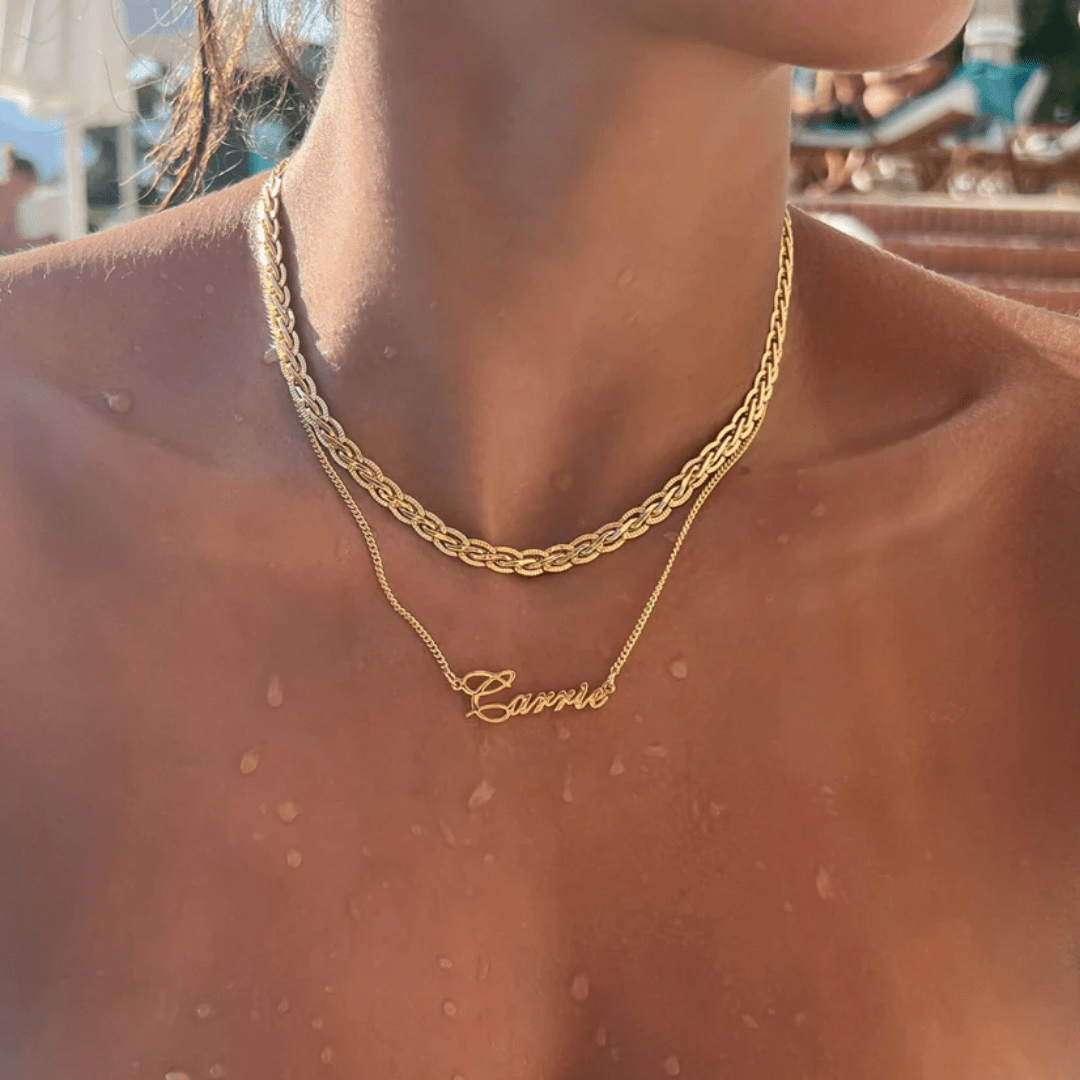
Pair a name with a stone and the necklace becomes yours alone
Custom script lettering next to a birthstone charm creates a piece that belongs to no one else. Choose the name, the stone, and the chain length to match your neckline and layering style.
View Name & Birthstone Necklace


January to June:
A Closer Look
Each of these first six birthstones carries its own character, from garnet's grounded warmth to pearl's soft luminosity. Whether you lean towards bold colour or quiet shimmer, the first half of the calendar offers something for every style.
The most interesting thing about birthstones is how personal they become once you start wearing them. A garnet pendant is not just red. It is January. It is your daughter, your partner, your best friend. That layer of meaning transforms a simple stone into something irreplaceable.

July to December:
The Final Six Stones
July: Ruby
Ruby is the stone of passion, confidence and vitality. Its vibrant red has been prized above almost all other gemstones throughout recorded history. For centuries, rubies were considered more valuable than diamonds, and they remain one of the four "precious" gemstones alongside diamond, sapphire and emerald.
A ruby birthstone paired with a warm gold setting creates a romantic, assured look that works for evening wear, celebrations, or any moment where your jewellery needs presence. The colour is intense but controlled, which is why ruby translates so well into smaller formats like pendants and charm bracelets. You do not need a large stone. Even a small ruby-toned charm carries unmistakable warmth.
August: Peridot
Peridot offers a fresh, light green that feels optimistic without being saccharine. Ancient Egyptians called it the "gem of the sun," partly because they believed it could only be found at night, when it supposedly glowed. The bright colour does have a genuinely uplifting quality that sets it apart from deeper greens like emerald.
Peridot pairs nicely with both gold and rose gold, and the lighter green softens denim, linen and casual layering. If your wardrobe leans towards neutral basics and relaxed tailoring, peridot adds a subtle pop of life without demanding a complete outfit rethink. It is one of the more wearable birthstones for daily styling.
September: Sapphire
Sapphire is the quintessential classic. Its deep royal blue symbolises loyalty, truth and wisdom, and it holds a Mohs hardness of 9, making it the second hardest natural gemstone after diamond. In the UK, sapphire carries extra cultural weight thanks to Princess Diana's famous sapphire engagement ring, now worn by Catherine, Princess of Wales.
For everyday birthstone jewellery, sapphire pairs perfectly with workwear neutrals: navy blazers, white shirts, grey tailoring, black dresses. It reads as polished and intentional without feeling overly formal. If you want a birthstone piece that transitions seamlessly from the office to dinner, sapphire handles that better than almost any other stone.
October: Opal and Tourmaline
Opal is the wildcard of the birthstone calendar. Its iridescent, colour-shifting surface contains traces of every colour, which means it works with both gold and silver settings and matches virtually any outfit. Opal symbolises creativity and imagination, fitting for a stone that never looks quite the same way twice.
Tourmaline, the alternative October stone, comes in an extraordinary range of colours, from pink to green to watermelon (pink and green combined). Both stones reward people who enjoy jewellery that shifts with the light and refuses to be pinned down to a single colour family.
November: Topaz and Citrine
Topaz in its golden yellow form represents joy, abundance and optimism. The warm tone is perfect for autumn and winter styling. Picture it layered under a chunky knit, paired with a camel coat, or sitting against a rich burgundy jumper. It brings warmth to a seasonal palette without the intensity of garnet or ruby.
Citrine, the alternative stone, shares that golden warmth but sits in a slightly lighter, more honeyed register. Both capture the feeling of late afternoon sunlight, which is why November babies tend to gravitate towards gold metal settings instinctively. The warmth of stone and metal reinforces each other beautifully.
December: Turquoise and Tanzanite
Turquoise closes the calendar with a distinctive blue-green that has been valued by cultures from the Egyptians to the Navajo for thousands of years. It symbolises protection, luck and inner calm. The bold colour makes it a natural standout against the dark fabrics and festive outfits that fill December wardrobes.
Tanzanite, discovered in Tanzania in 1967, offers a deep violet-blue alternative. It is one of the newest additions to the birthstone list and one of the rarest gemstones on earth. For personalised jewellery, turquoise remains the more widely recognised December stone, but tanzanite is a striking choice for anyone who favours cooler, violet-leaning tones.

July to December:
Rich Colours, Bold Choices
The second half of the birthstone calendar leans into deeper, bolder tones. Ruby, sapphire, emerald and tanzanite are among the most coveted gemstones in history. Wearing them as birthstone jewellery adds a personal dimension that generic fine jewellery simply cannot match.
From peridot's fresh green to turquoise's distinctive blue, these stones bring warmth and character to autumn and winter wardrobes. Layer them with gold chains for maximum impact.
Name Necklaces, Initials
and Bracelets
The three most popular formats for birthstone jewellery are name necklaces with a stone charm, initial pendants with a birthstone accent, and bracelets with stone details. Each suits a different styling approach.
Name necklaces with birthstone
This is the most personal format. Your name, or a loved one's name, written in custom script, with a small birthstone charm positioned beside it. The Moonela Name & Birthstone Necklace is the starting point: you select the name, the stone, and the chain length.
If you plan to wear it solo, 16 inches positions the pendant at the collarbone, which is the most flattering length for most necklines. If you want to layer it within a stack, go for 18 inches so there is room for a shorter chain to sit above it. Our name necklace styling guide covers layering combinations in detail.
Initial and birthstone pendants
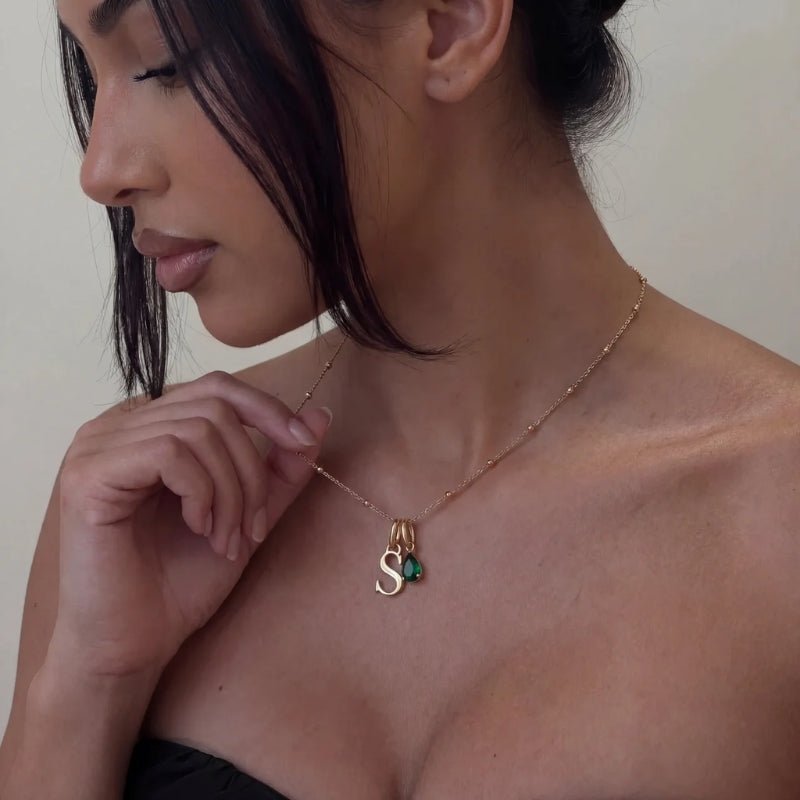
For something more understated, an initial pendant paired with a birthstone is ideal for daily wear and gifting. The stone adds colour and meaning without the visual weight of a full name. The Ayla Letter & Birthstone Necklace combines a single letter with a delicate stone drop, creating a minimal piece that layers easily with plain chains or chokers.
Initial pendants also work brilliantly as matching sets. Order two with different initials and different birthstones for a best friend pair, a mother-daughter duo, or a couple who want to carry each other's identity close.
Birthstone bracelets
Bracelets bring birthstones to a different part of the body and a different kind of visibility. You notice them when you gesture, type, or reach for something, which gives them a quiet, constant presence throughout the day.
The Personalised Birthstone Bracelet combines a birthstone charm with an initial on an adjustable gold chain. It works independently within a bracelet stack and is the easiest format for representing multiple people. Three children? Three birthstone charms on a single bracelet sit more comfortably than trying to squeeze three stones onto one necklace pendant.
| Format | Best For | Layering |
|---|---|---|
| Name + birthstone necklace | Maximum personalisation | Pairs with plain chains at different lengths |
| Initial + birthstone pendant | Subtle daily wear, gifting | Layers with chokers and longer chains |
| Birthstone bracelet | Multiple stones, wrist stacking | Sits alongside bangles and cuffs |

Birthstones belong wherever you can see them throughout the day
A birthstone charm and an initial on a waterproof adjustable chain. It stays on through showers, workouts and everything between. The most practical format when you want to carry multiple stones for multiple people.
View Birthstone Bracelet


An initial pendant with a birthstone keeps things minimal but meaningful
One letter. One stone. A piece that layers with everything and tells a story only you know. Works beautifully as a matching set for best friends, mothers and daughters, or couples.
View Letter & Birthstone Necklace


Styling Birthstone Jewellery
Through the Seasons
One advantage of birthstone jewellery is that the stone gives you a built-in accent colour. Here is how to make that colour work throughout the year.
Spring and summer
Lighter stones like aquamarine, pearl, peridot and opal come alive against bare skin and open necklines. Keep the rest of your jewellery simple so the stone's colour takes centre stage. A single birthstone pendant on a fine chain, paired with a sun-warmed collarbone and a linen shirt, is one of the cleanest summer jewellery looks you can build.
Deeper stones like garnet, ruby and sapphire create beautiful contrast against white and pastel clothing during warmer months. That unexpected pairing of a rich, warm stone against a light summer dress often reads as more intentional than matching light stone to light fabric.
Autumn and winter
This is where warmer birthstones truly earn their keep. Garnet, ruby, topaz and emerald feel completely at home against dark knits, wool coats and leather accessories. Layer a birthstone necklace under a V-neck jumper or let it rest above a turtleneck so the stone sits visibly against the fabric.
The colour acts as a subtle accent that lifts a neutral outfit without competing with it. If your winter wardrobe runs heavy on black, navy and grey, a single point of colour at the neckline changes the entire feel of an outfit. It is a small shift with a disproportionately large impact.
Work and formal settings
Keep to two or three pieces maximum. A birthstone necklace paired with a simple bracelet and one ring creates a polished, intentional look. Sapphire and diamond-inspired stones are the most office-neutral options. For more guidance on professional jewellery styling, our affordable personalised jewellery guide covers what works in formal settings.
Evening and occasions
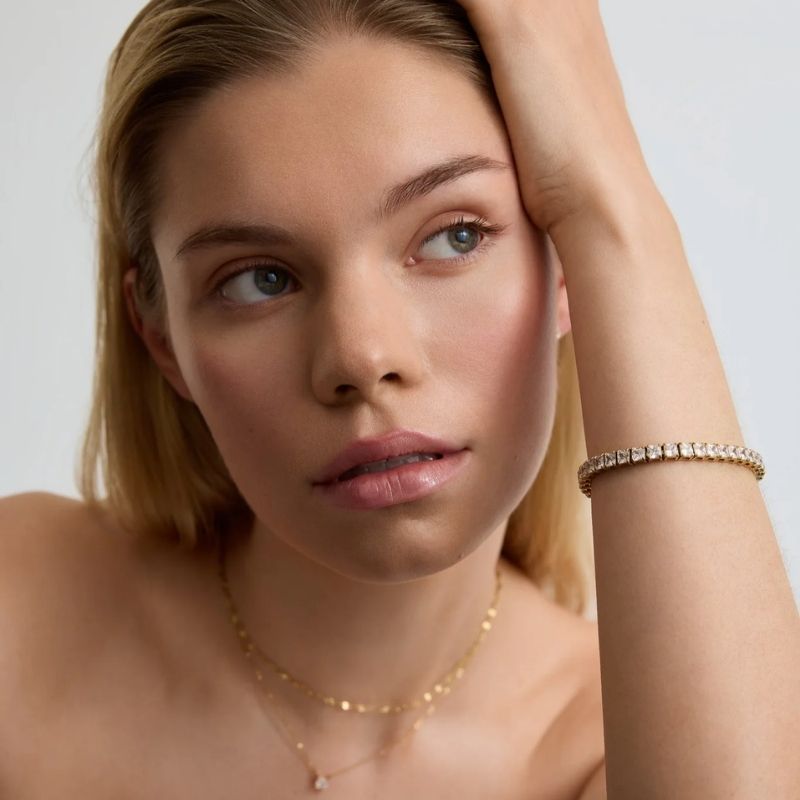
Layer a birthstone name necklace with a Tennis Necklace at a different length. The sparkle amplifies the colour, and the combination of personal meaning with visual impact feels considered and luxurious. This is birthstone jewellery at its most expressive.
A gold chain is lovely. A gold chain with your daughter's birthstone on it? That is irreplaceable.
Wearing Birthstones
With Confidence
The best birthstone jewellery does not announce itself. It sits quietly against your skin, catches the light at the right moments, and tells a story only you know. Whether layered with other pieces or worn alone, birthstone jewellery works across seasons and occasions.
Start with one meaningful piece and build from there. A birthstone necklace today, a matching bracelet next month. Before long, you have a collection that is entirely yours.

The Art of
Birthstone Gifting
Birthstone jewellery is one of the safest gifts you can give because it is inherently personal. The recipient knows you chose their specific stone, which signals thought and genuine care.
Match the month to the stone
Use the chart above to pair the recipient's birth month with the correct stone. If you are gifting to represent someone they love (a child, a partner), use that person's month instead. An initial and birthstone necklace lets you combine their letter with their stone for a doubly personal piece.
Choose the right format
For someone who already wears necklaces daily, a birthstone name necklace is the safest choice because it integrates into their existing style. For someone who prefers wrist jewellery, a birthstone bracelet makes more sense. If you genuinely have no idea what they wear, earrings tend to be the most universally flattering option.
Get the metal right
Gold or silver sets the tone for the entire piece. If you have noticed they usually wear gold, choose gold. If silver, choose silver. Getting the metal right honestly matters more than getting the stone size right. A small stone in the correct metal always looks more thoughtful than a larger stone in the wrong one.
Plan your timing
Personalised birthstone jewellery is made to order, which means production time before dispatch. Allow 5 to 8 working days for production plus standard UK delivery of 4 to 6 days. During peak periods like Christmas, Valentine's Day and Mother's Day, add an extra week as a buffer. The safest rule: order at least three weeks before you need the gift in hand.
Materials, Durability
and Care
Not all birthstone jewellery is made to the same standard. The quality of the metal base and the stone setting determines whether your piece lasts months or years.
Why PVD gold plating matters
The most durable option for everyday birthstone jewellery is stainless steel with PVD (Physical Vapour Deposition) gold plating. PVD creates a coating roughly ten times thicker than traditional electroplating. That thickness is what makes the difference between a necklace that tarnishes after a few months and one that looks the same a year later.
Every Moonela piece uses 18k gold PVD technology, bonded at a molecular level. The result is a surface that resists scratching, fading and tarnishing under normal daily wear. Sterling silver (925) is the alternative for anyone who prefers a cooler metal tone, offering genuine precious metal against the skin.
Waterproof vs water resistant
Waterproof birthstone jewellery (PVD-coated stainless steel) handles showers, light swimming, sweat and daily hand washing without tarnishing. Water-resistant jewellery (standard plating) should be removed before water contact. If you want a piece you never have to take off, which is the entire point of everyday birthstone jewellery, waterproof construction is non-negotiable.
For a full breakdown of how waterproof jewellery performs over time, our waterproof earrings guide covers real-world durability data and daily wear testing.
Stone setting quality
In personalised birthstone jewellery at accessible price points, stones are typically high-quality cubic zirconia, lab-grown, or natural semi-precious gemstones. This is completely standard across the industry. What actually matters is the setting: a well-set stone sits flush, does not wobble, and will not catch on clothing or hair. Bezel settings, where metal wraps around the stone's entire edge, are the most secure option for pieces worn every day.
Avoid plated brass if you plan to wear your piece daily. Brass-based plating looks fine initially but tends to wear through within a few months. If a product listing does not specify its base metal, that omission is usually telling.

Ten times thicker than traditional gold plating
18k gold PVD coating, bonded at a molecular level. It resists scratching, tarnishing and fading under real daily wear. Waterproof, hypoallergenic, and backed by a lifetime colour warranty.
Explore the CollectionFrequently Asked Questions
Can I wear a birthstone that is not my own month?
Yes, and many people do. Wearing the birthstone of a child, a partner or a close friend is one of the most meaningful ways to use birthstone jewellery. The personal connection you feel to the stone matters far more than whether it matches your own birthday.
Can I add multiple birthstones to a single piece?
Bracelets are the easiest format for multiple stones. They can hold several charms without looking crowded. Some necklace designs also accommodate two or three birthstones, which is a popular choice for parents representing their children on a single chain.
Are Moonela birthstone pieces waterproof?
Moonela jewellery is crafted from stainless steel with PVD gold plating, making it suitable for daily wear including showers, rain and normal hand washing. For best results, rinse gently after exposure to sea water or pool chlorine and pat dry before storing.
What is the difference between precious and semi-precious birthstones?
Diamond, emerald, ruby and sapphire are classified as precious. All other birthstones are semi-precious. In personalised jewellery at accessible prices, high-quality stone alternatives (like cubic zirconia for diamond) deliver the same visual impact and colour at a fraction of the cost.
Is birthstone jewellery safe for sensitive skin?
PVD-plated stainless steel and 925 sterling silver are both hypoallergenic and generally safe for reactive skin. If you have specific metal sensitivities, check the material details on the product page and introduce new pieces gradually to test your comfort.
How long does personalised birthstone jewellery take to arrive?
Personalised pieces are made to order and require 5 to 8 working days of production time, plus standard UK delivery (4 to 6 days). During peak periods such as Christmas, Valentine's Day and Mother's Day, allow an extra week. Ready-to-ship pieces dispatch within 1 to 2 working days.
Find Your Birthstone
Every stone carries a meaning. Every piece is personalised, waterproof, and backed by a lifetime colour warranty. Free UK delivery in a premium gift box.
Shop Birthstone JewelleryNot sure which stone? Send a message and the team will help you choose the right one.