Gold Cuff Bracelet 2026: Statement Bracelets Guide

Statement Bracelets
Are Having a Moment
The complete guide to bold wrist bijoux. Comment choose, stack and style personalised bracelets that turn a bare wrist into something worth noticing.
Pourquoi Bold Bracelets
Are Back in 2026
Colliers had their run. Bagues owned the layebague conversation for a while. Now the wrist is stepping forward, and the timing could not be better.
Something shifted in the bijoux landscape over the past twelve months. Scroll through any street-style gallery from London Fashion Week SS26 and you will notice a pattern: bare necklines paired with stacked wrists. Sculptural cuffs over rolled shirt cuffs. Gold chains catching the light every time a hand reaches for a coffee cup. Bracelets have moved from afterthought to focal point, and the trend shows no sign of slowing down.

Part of the appeal is practical. A bracelet does not compete with a neckline or a collar. It does not hide under a scarf when the temperature drops. And in a world where video calls are still a daily reality for most of us, your wrist is the part of you that stays visible regardless of camera angle. That small detail matters more than people realise.
But the deeper shift is cultural. Bijoux buyers are gravitating towards pieces that carry meaning, and the wrist turns out to be the perfect canvas for that. An engraved name, a set of initials, a birthstone tucked beside a textured bangle. These are not accessories you grab from a fast-fashion rack. They are chosen, stacked with intention, and worn daily. The personalisation wave that started with name colliers has moved to the wrist, and the result feels fresh.
There is also the confidence factor. Weabague a bold bracelet requires a certain ease. It catches eyes. It invites questions. That self-assuredness resonates with the broader 2026 mood, where bijoux is less about fitting in and more about owning what you love.
Four Bracelet Styles
Worth Knowing
Not every bold bracelet serves the same purpose. Understanding the role each style plays makes building a cohesive wrist far simpler.
This is your anchor piece. It carries meaning: an initial, a name, a date that only you recognise. The 2026 evolution of the charm bracelet is minimal and refined. Forget the overloaded chains of two decades ago. Today, a single meaningful charm on a clean chain is enough to ground an entire stack.
The beauty of starting with a personalised piece is that everything you add afterwards feels intentional. A textured bangle next to a name bracelet reads as curated. Two plain bangles on their own can read as incomplete. The personalised piece gives the rest of the stack context.


Where charm bracelets hang their meaning, bond bracelets engrave it directly into the metal. The text sits flush against your skin, visible only when the bracelet turns at just the right angle. It is one of the most popular gift formats for partners, mothers, and close friends because the engraving transforms a bracelet into a keepsake without adding bulk.
Bond bracelets also stack beautifully. Their flat, sleek profile sits close to the wrist and does not tangle with other pieces, which is a genuine practical advantage when you are layebague three bracelets on the same arm.
This is the visual heavyweight. A knot design, a hammered finish, a twisted wire shape. Sculptural cuffs bbague texture and dimension to a stack that would otherwise feel flat. The open-ended design fits any wrist without a clasp, which means no fumbling behind your back every morning.
One cuff per stack is the general rule. Its job is to add visual interest, not to dominate. Think of it like a statement earring: one draws the eye, two starts competing for attention.
Every great outfit has a supporting player, and in bracelet stacking, the slim chain fills that role. A fine gold chain or a delicate slider bracelet sits between your bolder pieces and prevents the stack from feeling heavy. It also creates width variation, which is one of the most reliable markers of a stack that looks considered rather than accidental.
If you are building your first stack, this is often the piece people overlook. They buy two bold bracelets and wonder why the combination feels crowded. A slim spacer between them fixes the proportion instantly.

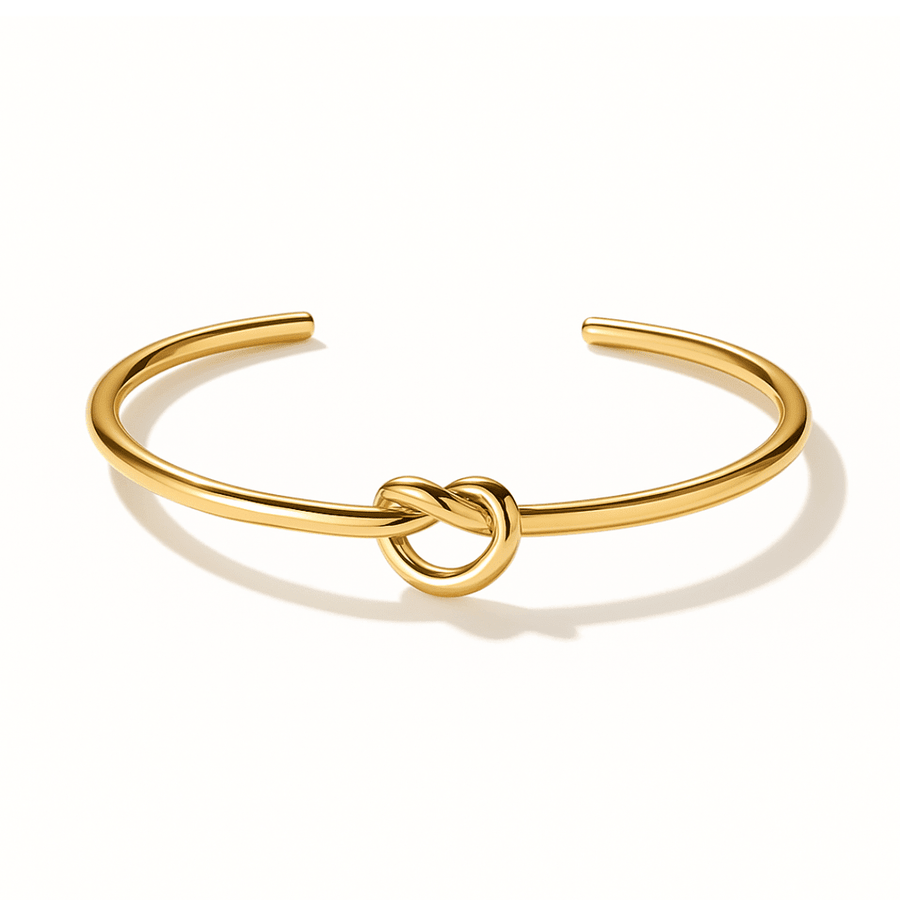
The Knot Cuff
A twisted knot silhouette that anchors any wrist stack with sculptural weight. The open cuff design adjusts to your wrist without a clasp, and the textured shape creates contrast even when paired with smooth chain pieces.


Eternal Bond Bracelet
Names, dates, or words engraved directly into the surface. The personalisation sits flush against your wrist, readable when you glance down and discreet when you want it to be. This is the bracelet that transforms a stack from decorative to deeply personal.


The Art of Building
a Wrist Stack
Stacking bracelets well is less about following strict rules and more about understanding proportion. Get that right, and everything else falls into place.
Three bracelets on one wrist is the sweet spot for 2026. One personalised anchor. One textured accent. One slim spacer. Each piece has a distinct width and a distinct role, and together they create enough visual complexity to look deliberate without overwhelming the arm.
Two bracelets often look like you meant to wear three. Four and above requires real skill to keep from tipping into clutter. Starting at three gives you a complete composition from day one, and you can always edit from there.


The single most common stacking mistake is choosing three bracelets of identical width. When every piece is the same thickness, the stack reads as uniform rather than styled. You want contrast: one wide piece (a cuff or bangle), one medium (a charm or bond bracelet), and one slim (a fine chain or slider). That variation in scale creates rhythm, the same principle that makes a well-proportioned outfit feel right even before you can articulate why.
Your stack should sit just above the wrist bone, where your forearm begins to narrow. This is the natural resting point where bracelets hold position without sliding. Adjustable pieces with slider clasps lock at the right tension, but if you are mixing fixed and adjustable bracelets, size the fixed one first and build your stack around it.
Keep your boldest piece closest to your hand and graduate upward. The largest bracelet at the lowest point creates a visual anchor, and the slimmer pieces above it draw the eye upward along the arm. It is a small detail, but it separates a stack that looks styled from one that looks random.
If you enjoy layebague across your whole look rather than just the wrist, our complete layebague guide covers combining bracelets with colliers, bagues, and earbagues into one cohesive outfit.
A well-built wrist stack tells people three things: you pay attention to detail, you value meaning over mass, and you know exactly what suits you.
Mixing Metals
Without Overthinking It
The old rule said pick one metal and stick to it. The 2026 rule says mix whatever you like, as long as you do it on purpose.
Mixed metals have moved from fashion-forward experiment to chaque jour norm. The most effective approach is what stylists call the 80/20 split: let one metal dominate (usually gold, since it pairs with the widest range of skin tones and wardrobe colours) and introduce the second metal as a single accent piece. A stack of two gold bracelets with one silver chain reads as intentional. A completely random mix of five metals reads as chaotic.
Texture contrast works alongside metal contrast. A smooth gold bond bracelet beside a hammered gold cuff creates visual interest without introducing a second colour at all. When you combine texture variety with metal variety, you get a stack that looks rich and considered, even when you are only weabague three pieces.
Or rose sits naturally between gold and silver, so it works as a bridge tone. If you find a straight gold-and-silver combination too stark, sliding a or rose piece between them softens the transition and makes the whole stack feel warmer.
For a more detailed look at how bague stacking follows similar metal-mixing logic, our bague stacking guide breaks down the same principles for fingers.
Outfit Paibagues
That Actually Work
A bracelet stack is only as strong as the outfit framing it. Here are the combinations that let your wrist do the talking.
Rolled sleeves and exposed cuffs
The simplest way to showcase a bracelet stack is to give it space. Roll your shirt sleeves to mid-forearm, push jumper cuffs above the wrist, or reach for three-quarter length tops. The contrast between fabric and bare skin creates a natural frame that draws attention downward. Gold bracelets against a navy rolled sleeve or a crisp white cuff is one of the strongest chaque jour paibagues you can build.
Watches and bracelets together
Weabague bracelets alongside a watch is not just acceptable in 2026, it is the preferred approach. The watch provides a functional anchor, and one or two bracelets on the same wrist add personality. The key is scale: keep the bracelets slimmer than the watch face so they support rather than compete. A personalised initial chain beside a minimal watch face looks effortless.
Bare arms and evening wear
Summer dresses, sleeveless tops, and evening gowns give bracelets their fullest stage. A stack of three gold pieces on a bare arm catches and releases light with every gesture. This is where bolder styles shine, because nothing else is competing for attention. If you are weabague a statement necklace, pare the wrist back to one or two subtle pieces. If your neckline is clean, let the bracelets carry all the visual weight.
The focal-point rule
Strong looks pick one zone and commit. If your wrist is the focal point, keep your collier simple or skip it altogether. If a layered collier is the hero, scale the bracelets back to a single slim piece. Competing focal points cancel each other out. For guidance on styling colliers alongside wrist bijoux, our name collier styling guide covers the balance in detail.

Every piece arrives in a premium box
A personalised bracelet is already a thoughtful gift. Packaging it in a magnetic presentation box elevates it further. No wrapping paper needed. The box itself says this was chosen with care, long before the recipient reads the engraving.
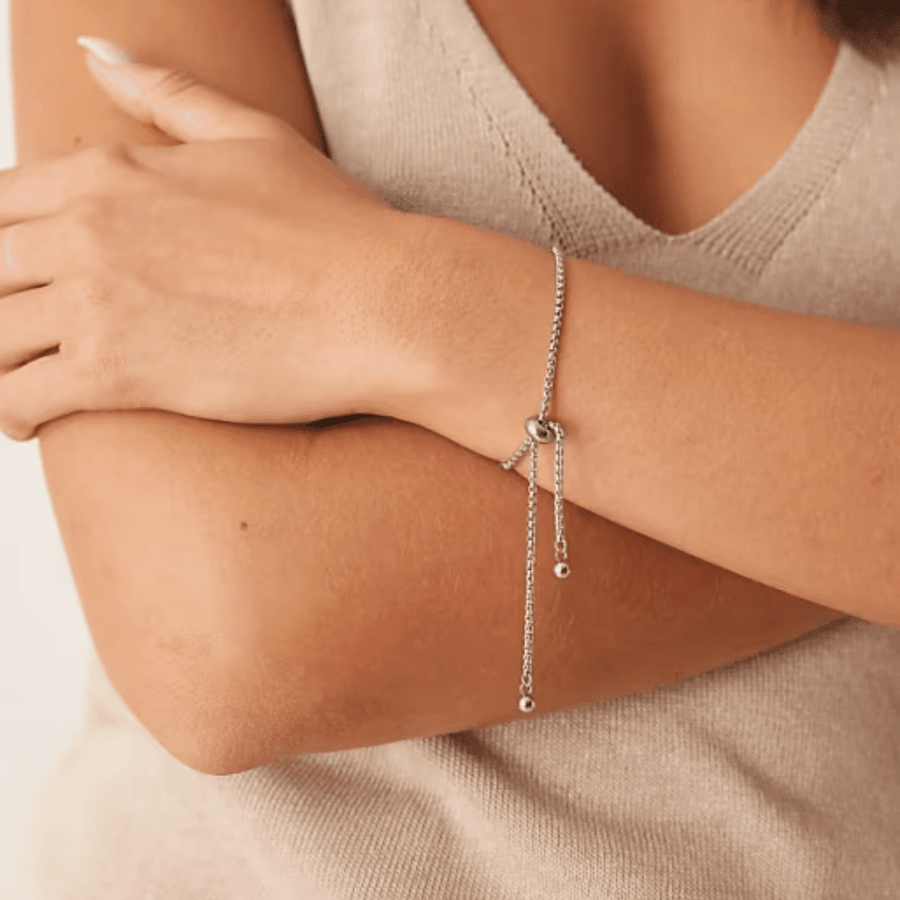
The Sleek Slider Bracelet
A fine adjustable chain that sits between your bolder pieces and ties the entire stack together. The sliding mechanism locks at the exact tension you need, so it stays put all day rather than drifting up your arm.


Durabilité and the
Imperméable Question
Bracelets take more daily punishment than any other piece of bijoux. If the finish cannot handle friction, moisture, and movement, the bracelet will not last a month.
Think about what your wrist goes through in a single day. It hits desk edges, catches on coat pockets, passes under taps, and sits against skin that warms and perspires. Traditional gold plating struggles with all of this, especially on bracelets. The contact points between stacked pieces create constant friction, and plating wears through those spots first. Within weeks, you start seeing dull patches. Within months, the base metal shows through.
PVD (Physical Vapour Deposition) gold coating changes the equation. Rather than applying a thin layer of gold on the surface, PVD bonds gold molecules to the acier inoxydable at a molecular level. The resulting layer is roughly ten times thicker than traditional plating and significantly harder. For bracelets, this is the difference between a piece that lasts six weeks and a piece that looks the same after a year of usage quotidien.
Moonela bracelets are built on 316L surgical-grade acier inoxydable with 18k gold PVD coating. They are fully imperméable, tarnish-resistant, and backed by a lifetime colour warranty. You can douche with them, nage with them, wash your hands dozens of times a day, and the finish holds. That durabilité is not a bonus feature. For stacking, it is the baseline requirement. Pieces that rub against each other all day need a finish tough enough to handle it.
For a deeper look at how PVD coating performs across different bijoux types, our imperméable bijoux guide covers every scenario from gym sessions to beach holidays.
Bracelet Style
Comparaison
A quick reference to help you pick the right pieces for your stack and your lifestyle.
| Style | Meilleur For | Stacking Role | Width |
|---|---|---|---|
| Charm bracelet | Personal meaning, gifting | Anchor piece | Medium |
| Bond bracelet | Engraved keepsakes, couples | Anchor piece | Medium |
| Sculptural cuff | Visual impact, texture | Accent piece | Wide |
| Slim chain / slider | Everyday wear, proportion | Spacer piece | Slim |
| Chain-link cuff | Edgier stacks, adjustability | Accent or anchor | Medium-wide |
Frequently Asked
Questions
Are statement bracelets on trend for 2026 in the UK?
Very much so. Bold wrist bijoux is one of the defining accessory trends for 2026. Personalised cuffs, engraved bond bracelets, and layered wrist stacks are leading the movement, especially when mixed with textured and sculptural shapes.
Comment many bracelets should you stack on one wrist?
Three is the ideal number. One personalised anchor, one textured accent, and one slim spacer. This gives you enough visual depth to look deliberate without tipping into clutter. Two can feel incomplete, and four or more requires careful curation to pull off well.
Can you mix gold and silver bracelets together?
Yes. Mixed metals are fully embraced for 2026. The most reliable approach is the 80/20 split: let one metal dominate and introduce the other as a single accent piece. Gold with one silver chain, or silver with one gold cuff, reads as intentional rather than mismatched.
Do stacked bracelets scratch each other?
With traditional plating, yes. The friction between stacked pieces accelerates plating wear at the contact points. PVD-coated bracelets on acier inoxydable are significantly harder and more resistant to this kind of surface friction, making them the only practical choice for daily stacking.
Can you wear bracelets alongside a watch?
Absolutely, and it is one of the strongest wrist styling moves for 2026. Keep your bracelets slimmer than the watch face so they complement rather than compete. A personalised chain beside a minimal watch creates a look that feels effortless and polished.
Are Moonela bracelets imperméable?
Yes. Every Moonela bracelet is made from 316L surgical-grade acier inoxydable with 18k gold PVD coating. They are fully imperméable, tarnish-resistant, and covered by a lifetime colour warranty. You can douche, nage, and exercise without removing them.
Build a Wrist That
Tells Your Story
Personalised, imperméable, and designed for chaque jour stacking. Lifetime colour warranty on every piece. Premium gift box included. 50% off everything.
Shop BraceletsNot sure where to start? Get in touch and we will help you build the perfect stack.