Arabic Islamic Jewellery UK 2026: Calligraphy Meaning Guide

Arabic Jewellery: The Art Behind the Script
From the golden domes of ancient mosques to the necklace resting against your collarbone, the story of how Arabic calligraphy became one of the most meaningful forms of jewellery in the world.
The History of Arabic Calligraphy in Adornment
Arabic calligraphy did not begin as decoration. It began as devotion. In the seventh century, as the Quran was transcribed for the first time, the scribes who rendered the words of God onto parchment understood something that has shaped the art ever since: the way a sacred word looks matters as much as what it says. Those early scribes did not merely copy text. They elevated writing into an act of worship, refining every curve, every stroke, every connection between letters until the script itself became beautiful enough to honour the words it carried. That impulse, to make the written word physically beautiful, is the root of everything Arabic jewellery means today.
The earliest examples of Arabic script used for adornment appear in the architecture of the Umayyad period, from the late seventh century onward. The Dome of the Rock in Jerusalem, completed in 691 CE, features Quranic verses rendered in gold mosaic along its interior and exterior walls. This was not merely informational. It was a deliberate choice to use the beauty of Arabic script as a form of visual splendour, a way of making the words of the Quran feel as magnificent as their meaning. The script was not hidden inside a book. It was displayed publicly, turned into art, woven into the very fabric of sacred space.
From architecture, the tradition of Arabic calligraphy as adornment spread rapidly. By the Abbasid period in the eighth and ninth centuries, Arabic script appeared on coins, ceramics, textiles, metalwork, and personal objects. Wealthy patrons commissioned calligraphers to inscribe blessings, names, and Quranic verses on rings, amulets, and brooches. These were not mass-produced items. Each piece was individually crafted by a calligrapher who had spent years training under a master, learning the precise proportions and rhythms of the script. The result was jewellery that carried both aesthetic beauty and spiritual protection, a combination that remains at the heart of Arabic jewellery today.
A Living Tradition
The Islamic Golden Age, spanning roughly the eighth to the fourteenth centuries, saw Arabic calligraphy reach extraordinary levels of sophistication. Master calligraphers like Ibn Muqla and Ibn al-Bawwab codified the proportional systems that underpin the major calligraphic styles, establishing mathematical relationships between letter heights, widths, and curves. These systems ensured that Arabic script was not just beautiful by accident but beautiful by design, every letterform following rules of proportion as rigorous as those used in classical architecture. When you see Arabic calligraphy on a piece of jewellery today, the proportions of those letters trace directly back to systems developed over a thousand years ago.
The tradition of wearing Arabic script on the body has deep roots in Islamic culture. The Prophet Muhammad (peace be upon him) is reported to have worn a silver ring inscribed with the words محمد رسول الله (Muhammad, Messenger of God), which he used as a seal for official correspondence. This hadith, recorded in Sahih al-Bukhari, establishes a direct connection between the earliest days of Islam and the practice of wearing inscribed jewellery. The Prophet's ring was functional, it served as a seal, but it was also deeply personal, carrying his name and mission statement on his hand at all times.

Worn with Meaning
Throughout the Ottoman period, inscribed jewellery became increasingly elaborate. Sultans and members of the court wore rings, pendants, and brooches inscribed with their names, titles, and verses from the Quran, often in gold set with precious stones. The tughra, the elaborate calligraphic signature of the Ottoman sultan, became one of the most recognisable forms of Arabic calligraphy used as adornment, appearing on everything from official documents to jewellery to architectural decoration. The tughra demonstrated that Arabic calligraphy could be simultaneously a personal identifier, a work of art, and a statement of authority.
Today, Arabic jewellery carries this entire history within it. When someone wears a necklace inscribed with their name in Arabic calligraphy, they are participating in a tradition that stretches back over fourteen hundred years, from the scribes of the first Quran to the architects of the Dome of the Rock, from the master calligraphers of Baghdad to the Ottoman court, and now to the personalised pieces crafted for people in the UK and around the world who want to carry the beauty and meaning of Arabic script against their skin.

Centuries of Craft
Not all Arabic calligraphy looks the same. Over the centuries, distinct styles emerged, each with its own character, proportions, and visual personality. Understanding these styles helps you choose the right one for your jewellery.
Understanding Arabic Calligraphy Styles
Arabic calligraphy encompasses dozens of recognised styles, but four are particularly relevant when it comes to Arabic jewellery: Naskh, Thuluth, Diwani, and Nastaliq. Each creates a different visual effect when rendered in gold on a necklace, bracelet, or ring, and each carries its own cultural associations and aesthetic qualities.
Naskh: the elegant standard
Naskh is the most widely used Arabic script in the world. It is the style used in printed books, newspapers, and digital text across the Arab world. Developed in the tenth century by the calligrapher Ibn Muqla, Naskh is defined by its clarity, readability, and balanced proportions. The letters sit neatly on the baseline with consistent heights, and the connections between letters are smooth and understated. On jewellery, Naskh creates a clean, refined look. Every letter is immediately legible, even at the small scale required for a necklace or bracelet. This makes Naskh the most popular choice for Arabic name necklaces and bracelets where readability matters, you want the recipient and anyone who speaks Arabic to be able to read the inscription clearly.
Thuluth: the grand statement
Thuluth is the script of mosques, Qurans, and monumental inscriptions. Developed alongside Naskh, Thuluth is characterised by its elongated vertical strokes, dramatic curves, and ornamental quality. Where Naskh is practical, Thuluth is theatrical. The letters rise higher, sweep more dramatically, and create compositions that are as much visual art as written language. On jewellery, Thuluth creates a bolder, more decorative effect. It works particularly well for short words and phrases, بسم الله (Bismillah) in Thuluth looks magnificently architectural. However, for longer names, Thuluth can become visually complex at small scales, which is why it is more commonly chosen for statement pieces than for everyday name jewellery.

Find Your Script
Diwani was developed in the Ottoman court for official documents and correspondence. It is characterised by its flowing, interconnected letters that seem to dance across the line, with exaggerated curves and a distinctive rightward slant. Diwani has a romantic, almost musical quality, the letters tumble and cascade in ways that feel spontaneous despite being meticulously structured. On Arabic jewellery, Diwani creates a sense of movement and emotion that pairs beautifully with love-related inscriptions. A bracelet inscribed with حبيبتي (Habibti, My love) in Diwani script has a visual warmth and intimacy that perfectly matches the meaning of the word. The flowing connections between letters also create a continuous visual line that works particularly well on the curved surface of a ring.
Diwani: flowing romance
Nastaliq: poetic grace
Nastaliq developed primarily in Persia and is the dominant script for Urdu, Farsi, and some other languages that use the Arabic alphabet. It is characterised by a steep diagonal slant, with letters cascading from upper right to lower left, creating a visual rhythm that has been compared to the movement of a waterfall. Nastaliq is one of the most visually striking Arabic scripts, and it carries strong cultural associations for South Asian Muslim communities. For British Muslims of Pakistani, Indian, or Bangladeshi heritage, Nastaliq can feel more culturally specific and personal than Naskh. On jewellery, the diagonal flow creates a dynamic, artistic effect, though it requires skilled execution at small scales to maintain legibility.
Every calligraphic style tells a different story. Naskh whispers with clarity. Thuluth proclaims with grandeur. Diwani flows with emotion. Nastaliq cascades with grace.
| Style | Character | Best For |
|---|---|---|
| Naskh | Clean, balanced, highly readable | Names, everyday pieces, longer inscriptions |
| Thuluth | Grand, ornamental, architectural | Short phrases, Quranic verses, statement pieces |
| Diwani | Flowing, romantic, interconnected | Love words, emotional inscriptions, rings |
| Nastaliq | Diagonal, poetic, culturally specific | Urdu names, South Asian heritage pieces |

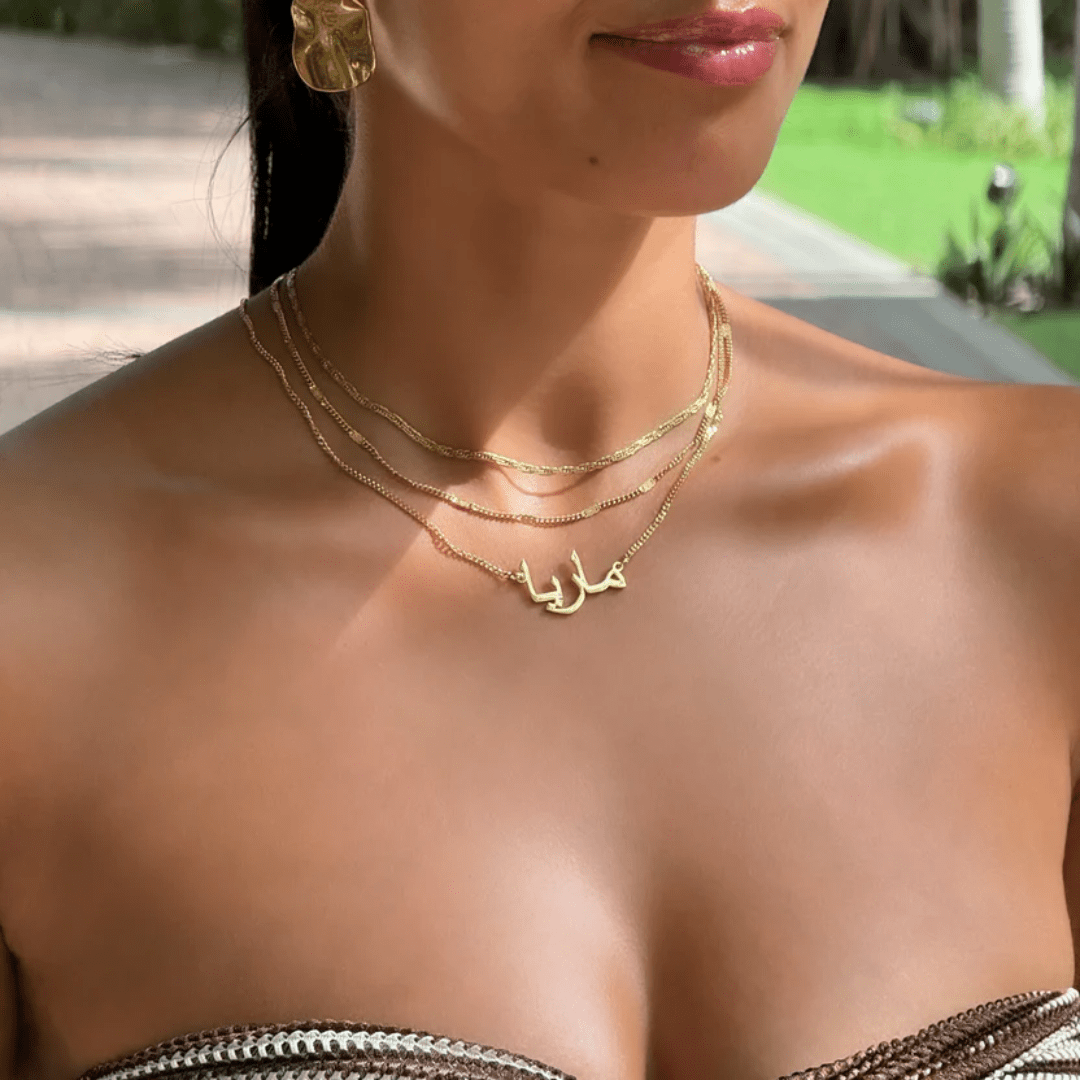
Arabic Name Necklace
Your name or a meaningful word rendered in flowing Arabic calligraphy, suspended from a delicate chain in warm 18k gold. The script maintains its authentic proportions and connections, creating a piece that is both deeply personal and artistically considered. The most popular way to wear Arabic calligraphy close to your heart.
Personalised with any name or word in Arabic calligraphy. 18k PVD gold on surgical-grade 316L stainless steel. Waterproof and tarnish-resistant. Free UK delivery.
From £34.95
Create Your Necklace

What Makes Arabic Script Unique on Jewellery
There are hundreds of writing systems in the world, but Arabic script has qualities that make it exceptionally suited to jewellery. Understanding why Arabic calligraphy looks so extraordinary when rendered in gold helps explain why Arabic jewellery has captured the imagination of people far beyond the Arabic-speaking world.
Arabic is written from right to left, which means the script flows in the opposite direction to English and most European languages. On a necklace or bracelet, this creates a visual movement that feels distinctive and immediately recognisable. The right-to-left flow gives Arabic calligraphy necklaces a directional energy, the eye follows the script in a way that creates a sense of motion across the chest or wrist. This is not merely a curiosity. It is one of the reasons why Arabic script looks fundamentally different from any Latin-alphabet inscription, giving the jewellery an unmistakable identity.


Unlike English, where most printed letters stand independently, Arabic letters connect to each other within words. This means that a name or word in Arabic calligraphy is not a series of separate shapes but a single, flowing line that rises and falls, thickens and thins, curves and straightens. On jewellery, this connectivity is visually powerful. An Arabic name necklace presents a continuous, unbroken line of gold that traces the shapes of a name in a way that feels organic and alive. Where a Latin-script name necklace reads as individual characters lined up side by side, an Arabic script necklace reads as a single, fluid composition, more like a piece of abstract art than a line of text.
Arabic letters are distinguished in part by dots placed above or below the letterforms. These diacritical marks, one dot, two dots, or three dots in various positions, add a layer of visual texture that no Latin-script jewellery can replicate. On a gold necklace or bracelet, the dots catch light independently from the main body of the letters, creating a subtle sparkle and depth. The dots function like tiny punctuation marks that break up the flow of the script in pleasing ways, adding visual interest without disrupting the overall continuity of the word.
Arabic calligraphy does not spell a word. It draws a word. Every name becomes a piece of art the moment it is written in Arabic script.

Popular Arabic Words and Their Meanings
The Arabic language contains words of such beauty and emotional depth that English translations can only approximate their meaning. Here are the words most commonly chosen for Arabic jewellery, and why they matter.
The most popular choice for Arabic jewellery is, simply, a name. Your own name, the name of someone you love, the name of a child. Arabic calligraphy transforms even the most common name into something visually extraordinary. A name that looks ordinary in English becomes a flowing work of art in Arabic script. For people with Arabic names, seeing it written in its original script is a return to roots. For people whose names are transliterated from other languages, the Arabic rendering adds a layer of cultural connection that Latin script cannot provide. Names are universal, everyone has one, everyone connects to one, and Arabic calligraphy elevates them from simple identification to personal art.


Bismillah is the most frequently spoken phrase in the Muslim world. It is said before eating, before travelling, before beginning any task, a verbal invocation of God's name at the start of every action. On jewellery, Bismillah is a constant reminder to begin everything with intention and awareness. Wearing it means carrying that invocation with you at all times, whether you speak it aloud or not. On a necklace, it rests near your heart. On a bracelet, it faces you as a visible anchor during every moment of the day. Bismillah is the most popular religious inscription on Arabic jewellery in the UK, chosen by people who want their faith to be a quiet, permanent presence rather than something that only appears during prayer.
Masha'Allah is an expression of gratitude, wonder, and protection. It is spoken when something good happens, when you see beauty, receive a blessing, or witness something that fills you with awe. In many Muslim cultures, saying Masha'Allah is also believed to protect the person or thing you are admiring from the evil eye. On jewellery, it serves as both a personal reminder of gratitude and a form of spiritual protection. A necklace or bracelet inscribed with Masha'Allah says: I recognise the blessings in my life, and I carry that recognition with me always.
Insha'Allah expresses hope and trust in God's plan. It is spoken when discussing anything that lies in the future, a way of acknowledging that outcomes are ultimately in God's hands, not ours. On jewellery, Insha'Allah represents surrender to the divine will, a gentle acceptance that whatever comes is what was meant to be. It is a particularly meaningful inscription for people going through transitions, new jobs, new cities, new chapters, who want a reminder that the future is held by something greater than their own planning.
Habibi (masculine) and Habibti (feminine) are the most widely known Arabic terms of endearment. They translate literally as "my love" or "my darling," but the word carries a warmth and tenderness in Arabic that the English equivalent cannot quite capture. In the Arab world, Habibi and Habibti are used not just between romantic partners but between parents and children, between close friends, between anyone bound by genuine affection. On a necklace or bracelet, the word becomes a permanent declaration of love, visible, tangible, and worn against the skin of the person who means the most to you.
Ya Hayati is one of the most emotionally powerful expressions in Arabic. It means "Oh my life" or "You are my life" and is used to express that someone is so essential to you that your very existence is intertwined with theirs. It is a term used between lovers, between parents and children, between anyone whose bond is so deep that one cannot imagine life without the other. On Arabic jewellery, Ya Hayati is a profoundly romantic inscription that goes beyond Habibi in emotional intensity. It is the word you choose when "my love" is not enough.
Salam means peace, and it is one of the most important concepts in Islam. It is the root of the word Islam itself, and it forms the basis of the Muslim greeting Assalamu Alaikum (Peace be upon you). On jewellery, Salam is a single, powerful word that speaks to a universal aspiration. It works as a personal reminder, a call to cultivate inner peace, and as a statement of values visible to the world. The word Salam in Arabic calligraphy is also strikingly beautiful, with the letters flowing into each other in a compact, balanced composition that looks elegant at any scale.


Arabic Calligraphy Bracelet
Your chosen word or name handcrafted in flowing Arabic calligraphy and wrapped around your wrist in waterproof 18k gold. The bracelet faces inward, keeping the inscription visible to you throughout the day, a private reminder of what matters most, written in the world's most beautiful script.
Personalised with any name or word in Arabic. 18k PVD gold on 316L surgical-grade stainless steel. Completely waterproof. Adjustable chain.
From £41.95
Create Your Bracelet
Arabic Jewellery in British Culture
The United Kingdom is home to one of the largest and most diverse Muslim communities in Europe. Over four million Muslims live in Britain, representing a vast range of ethnic backgrounds, languages, and cultural traditions, but united by a shared connection to Arabic as the language of the Quran, of prayer, and of some of the most important words in their lives. This is the context in which Arabic jewellery in the UK has become not just a niche product but a growing cultural phenomenon.
For first-generation immigrants from the Arab world, South Asia, Turkey, North Africa, and East Africa, Arabic script is part of the visual landscape of their childhood, on shop signs, in books, on the walls of mosques. Arabic gold jewellery has always been central to their culture, particularly in Arab communities where gold is given to mark weddings, births, and religious milestones. For this generation, wearing Arabic jewellery in Britain is a continuation of a tradition they grew up with.


For second and third-generation British Muslims, the relationship with Arabic is different but no less meaningful. Many grew up speaking English at school and their parents' language at home. They learned to read Arabic for Quran recitation at the mosque but may not speak it fluently in daily life. For this generation, a piece of Arabic jewellery serves as a bridge, a way of carrying their heritage visibly in a society where they navigate between cultures every day. A name necklace in Arabic script is not a costume or a statement of difference. It is a natural expression of an identity that encompasses both Britain and the wider Muslim world.
One of the most interesting developments in UK culture over the past decade is the growing appreciation of Arabic calligraphy among people who are not Muslim and do not speak Arabic. The visual beauty of the script has attracted fashion designers, tattoo artists, interior designers, and jewellery enthusiasts from all backgrounds. Arabic calligraphy necklaces are worn by people who fell in love with the aesthetic while travelling in Morocco, Turkey, or the Gulf states. They are worn by people who studied Arabic at university and want to carry a word from a language they love. They are worn by people who simply find the script the most beautiful form of writing they have ever encountered.
Arabic calligraphy was never meant to belong to a single nation or culture. It belongs to anyone who recognises its beauty and honours its meaning.

Gold in Islamic Tradition
The association between gold and Arabic calligraphy is not accidental. Gold holds a profound place in Islamic art, architecture, and culture, a significance that stretches back to the earliest days of the faith and continues to shape the way Arabic gold jewellery is understood and valued today.
In Islamic art, gold represents divine light. The great mosques of the world, the Dome of the Rock in Jerusalem, the Al-Aqsa Mosque, the Sultan Ahmed Mosque in Istanbul, the Sheikh Zayed Grand Mosque in Abu Dhabi, all feature gold prominently. Gold calligraphy adorns their walls, domes, and prayer niches. Gold mosaics catch the light, creating an atmosphere of transcendent beauty. This is not merely decorative. In Islamic artistic philosophy, light is a metaphor for the divine presence, and gold, with its warm, enduring glow, is the material most closely associated with that light. When Arabic calligraphy is rendered in gold, it inherits this symbolism: the words become luminous, carrying not just linguistic meaning but a visual suggestion of the sacred.
Gold and the Quran
Some of the most extraordinary examples of Arabic calligraphy in history are the illuminated Qurans produced during the Abbasid, Mamluk, and Ottoman periods. These manuscripts featured Arabic text written in gold ink on coloured parchment, often deep blue or burgundy, with elaborate geometric borders and floral decorations. The Blue Quran, produced in ninth-century Tunisia, is one of the most famous examples: gold Kufic script on indigo-dyed parchment, creating a visual effect that is simultaneously serene and magnificent. The tradition of writing the Quran in gold established an enduring association: Arabic calligraphy and gold belong together. When you see Arabic script in gold, whether on the wall of a mosque or on a piece of Arabic jewellery, the combination feels right because it echoes a partnership that has existed for over a thousand years.
Gold in Arab wedding traditions
In Arab cultures, gold jewellery plays a central role in marriage traditions. The mahr (dowry) given to the bride often includes gold jewellery, which becomes her personal property. In many Gulf states, the bride is adorned with elaborate gold sets, necklaces, bracelets, earrings, and headpieces, that represent both the groom's commitment and the bride's financial security. This tradition has made gold jewellery one of the most emotionally charged gifts in Arab culture. A piece of Arabic gold jewellery given to a woman is not just an accessory, it is a statement of value, commitment, and respect that carries the weight of centuries of cultural practice.
Why gold enhances Arabic calligraphy
Beyond cultural symbolism, gold has practical qualities that make it the ideal metal for Arabic script. The warm reflectivity of gold catches light in the curves and connections of the calligraphy, making each letterform appear three-dimensional. As the wearer moves, different parts of the script catch the light, creating a subtle play of shadow and highlight that brings the calligraphy to life. Silver, by contrast, has a flatter reflectivity that can make fine calligraphic details appear less defined, particularly in the thin connecting strokes between Arabic letters. Gold reveals the calligraphy; silver can flatten it. This is why Arabic gold jewellery remains the overwhelming preference for calligraphy-based pieces, both in the Arab world and in the UK.

Arabic Calligraphy Ring
A single word or name in Arabic script, set into a ring that wraps the calligraphy around your finger. The most understated way to carry Arabic calligraphy with you, personal, discreet, and quietly meaningful. Following a tradition that stretches back to the Prophet Muhammad's own inscribed ring.
Personalised with any name or word in Arabic calligraphy. 18k PVD gold on surgical-grade stainless steel. Waterproof and tarnish-resistant.
From £32.95
Create Your Ring

Built for Real Life
The tradition of Arabic jewellery may stretch back fourteen centuries, but the technology behind modern pieces has changed dramatically. If you are considering a piece of Arabic calligraphy jewellery, understanding the difference between PVD coating and traditional gold plating will help you make an informed choice, and understand why some pieces last years while others deteriorate within weeks.
Modern Arabic Jewellery: PVD vs Traditional Gold Plating
Traditional gold plating: the old method
Traditional electroplating submerges the base metal in a chemical bath containing dissolved gold. An electrical current causes a thin layer of gold to bond to the surface. The result looks beautiful, initially. The problem is that the bond is chemical rather than physical, which makes it vulnerable to friction, moisture, sweat, and the ordinary wear that jewellery experiences daily. On Arabic calligraphy jewellery, this is particularly problematic because the script contains intricate details, thin connecting strokes between letters, diacritical dots, fine curves, that are the first areas to lose their plating. Within weeks or months of daily wear, traditional gold plating begins to show the base metal beneath, starting with the most delicate parts of the calligraphy. The very details that make Arabic script beautiful are the first to disappear.
PVD coating: the modern standard
PVD (Physical Vapour Deposition) represents a fundamentally different approach. Instead of a chemical bath, PVD uses a vacuum chamber to vaporise gold atoms and bond them directly to the metal surface at a molecular level. The gold does not sit on top of the metal, it becomes part of it. This molecular bond is dramatically more durable than chemical plating. PVD-coated Arabic jewellery resists scratching, peeling, water damage, and the everyday friction that destroys traditional plating. The calligraphy remains crisp and defined for years of continuous wear, even in the most delicate areas of the script.
Why this matters for daily wear
If you intend to wear your Arabic jewellery every day, and most people do, because the inscriptions carry too much personal meaning to leave in a drawer, the coating technology is the single most important factor in your purchase. A beautiful Arabic calligraphy necklace is worthless if the gold flakes off the Bismillah inscription after two months. PVD coating combined with 316L surgical-grade stainless steel creates a piece that genuinely withstands daily life: showering, hand washing, cooking, exercising, and for those who perform wudu, multiple daily water contact. The gold maintains its warm, consistent colour for two to five years of continuous wear.
| Feature | Traditional Plating | PVD Coating |
|---|---|---|
| Bond type | Chemical (surface layer) | Molecular (integrated) |
| Lifespan | Weeks to months | Two to five years |
| Water resistance | Poor, accelerates deterioration | Fully waterproof |
| Calligraphy detail | Fine details fade first | Details remain crisp throughout |
| Scratch resistance | Low, scratches easily | High, significantly harder surface |
| Skin safety | Varies, base metal can cause reactions | Hypoallergenic (316L stainless steel) |
The best Arabic calligraphy in the world means nothing if the gold it is rendered in does not last. The script is timeless. The metal should be too.
Every piece in the Moonela personalised collection uses 18k PVD gold on 316L surgical-grade stainless steel. This is a deliberate choice: Arabic calligraphy is too beautiful and too meaningful to be rendered in materials that cannot endure daily life. The combination ensures that the calligraphy remains as defined and the gold as warm on the thousandth day of wear as on the first.

Make It Personal
Whether you are buying for yourself or choosing a gift for someone you love, picking the right Arabic jewellery involves three decisions: the type of piece, the inscription, and the calligraphy style. Here is how to approach each one.
How to Choose Your First Arabic Piece
Necklace: the most visible expression
An Arabic name necklace is the most popular form of Arabic jewellery, and for good reason. It sits at the centre of the chest, visible to the world, making it a bold but elegant expression of identity, faith, or love. A necklace works particularly well for names and longer words because the pendant hangs freely, giving the calligraphy space to breathe. The natural movement of a necklace also means the script catches light from different angles throughout the day, revealing the beauty of the calligraphy in constantly shifting ways. If you are buying your first piece of Arabic jewellery and want something that will become an everyday signature, start with a necklace.
Bracelet: the personal reminder
An Arabic calligraphy bracelet sits on the wrist, facing you. This makes it fundamentally different from a necklace in terms of emotional function. A necklace shows the world who you are. A bracelet reminds you who you are. For inscriptions that carry private significance, a word of faith that grounds you, a name that comforts you, a reminder to be patient or grateful, a bracelet places the calligraphy exactly where your eye falls throughout the day. Every time you glance at your wrist, the inscription is there. For people who perform wudu, a waterproof Arabic bracelet is particularly practical: it stays on through every washing, every prayer, every day of the week.
Ring: the quiet statement
An Arabic calligraphy ring is the most understated form of Arabic jewellery. The inscription wraps around your finger, intimate, subtle, present in every gesture you make. Rings work best for single words or very short names because the circumference of a ring limits how much text can be displayed while maintaining legibility. Sabr (patience), Noor (light), a short name, these create compact, balanced calligraphy that looks perfectly proportioned on a ring. The ring format also carries historical resonance: it echoes the inscribed ring of the Prophet Muhammad, connecting you to the oldest tradition of Arabic jewellery in existence.
Choosing your inscription
The inscription is the most personal part of the decision. If you speak Arabic, you know what word or name resonates most deeply. If you are choosing a name in Arabic for the first time, consult a fluent Arabic speaker, ideally someone from the same cultural background as the person who will wear the piece, to confirm the correct spelling. Many names have multiple accepted Arabic forms, and the right spelling often depends on family or regional tradition. For religious inscriptions like Bismillah or Masha'Allah, the spellings are standardised, so there is no ambiguity.
Consider the recipient's style
If you are choosing Arabic jewellery as a gift, pay attention to what the recipient already wears. Does she favour delicate, minimal jewellery? A necklace with a short name or single word will integrate seamlessly into her existing collection. Does she wear statement pieces? A bracelet with a longer inscription makes more of a visual impact. Does she prefer rings over other jewellery? The Arabic calligraphy ring allows her to wear the script in the format she already gravitates toward. Matching the type of jewellery to the recipient's personal style ensures the piece becomes something she actually wears every day, which, for a personalised piece with this much meaning, is the entire point.
| Piece | Visibility | Best Inscription Length | Emotional Function |
|---|---|---|---|
| Necklace | High, seen by the world | Names and phrases up to 4 words | Identity and expression |
| Bracelet | Medium, seen by you | Names and words up to 3 words | Personal reminder and grounding |
| Ring | Subtle, intimate | Single words or short names | Quiet, constant presence |
Frequently Asked Questions
Straight answers to the questions we hear most about Arabic jewellery, its meaning, and how to choose the right piece.
What does Arabic jewellery symbolise?
Arabic jewellery symbolises a connection to heritage, faith, identity, and personal meaning. For people with Arabic or Muslim backgrounds, wearing Arabic calligraphy is a way of carrying their roots and their beliefs visibly and beautifully. The specific symbolism depends on the inscription: a name represents identity and love, Bismillah represents faith and intention, Masha'Allah represents gratitude, Sabr represents patience and endurance. Beyond individual inscriptions, Arabic calligraphy itself is a UNESCO-recognised art form with over fourteen centuries of history, so wearing it also connects you to one of the world's great artistic traditions.
Can I wear Arabic jewellery if I am not Arab or Muslim?
Yes, provided you approach it with respect and understanding. Arabic calligraphy is a global art form that has been admired and adopted across cultures for centuries. The key is to know the meaning of what you are wearing. Choose an inscription whose meaning resonates with you, your own name in Arabic, a word like Salam (peace) or Noor (light) that carries universal significance, or a phrase that connects to a personal experience. Avoid wearing religious phrases like Bismillah or Quranic verses purely as fashion if they hold no spiritual meaning for you. When worn with genuine appreciation for both the art and the culture, Arabic jewellery can be a beautiful form of cross-cultural admiration.
Which Arabic calligraphy style is best for jewellery?
For most people, Naskh is the best starting point. It is the clearest, most readable Arabic script, and it maintains its legibility even at the small scales required for necklaces, bracelets, and rings. If you want a more decorative, ornamental look, Thuluth creates a grand visual effect but works best for shorter inscriptions. Diwani has a flowing, romantic quality ideal for love words and emotional inscriptions. Nastaliq is particularly meaningful for people of South Asian heritage. If you are unsure, Naskh is the universally safe and beautiful choice.
Is Arabic gold jewellery waterproof?
It depends entirely on how the gold is applied. Traditional gold-plated Arabic jewellery is not waterproof, water exposure accelerates the deterioration of the plating, and the gold can begin to wear away within weeks of regular contact with water. PVD-coated Arabic jewellery, like all pieces in the Moonela collection, is genuinely waterproof. The PVD process bonds gold to the stainless steel at a molecular level, creating a surface that is impervious to water, sweat, and moisture. You can shower, swim, perform wudu, and wash your hands without removing the jewellery or worrying about damage.
How do I ensure my name is spelled correctly in Arabic on the jewellery?
If you read Arabic, provide the exact spelling you prefer when ordering. If you need to transliterate a name from English into Arabic, consult a family member or friend who is fluent in Arabic. Many names have multiple accepted Arabic spellings that vary by country, region, and family tradition. For example, Sarah can be written as سارة or سارا, and the choice is personal. For religious phrases like Bismillah or Masha'Allah, the spellings are standardised and there is no ambiguity. When in doubt, ask someone who knows the recipient's specific cultural background, the attention to detail will be noticed and deeply appreciated.
Discover Arabic Jewellery
Every Moonela piece is crafted with 18k PVD gold on surgical-grade stainless steel. Waterproof, tarnish-resistant, and personalised with your name or meaningful word in beautiful Arabic calligraphy. An art form that spans fourteen centuries, made for you to wear every single day.
Create Your Arabic PieceFree UK delivery · Tarnish-free guarantee · Easy returns
Related Collections
- Arabic Name Necklaces — Flowing Arabic script in waterproof 18K gold, made to order.
- Arabic Calligraphy Rings — Any name rendered in proper Arabic script, wrapped around the finger.
- Personalised Rings — Engrave a name, initial, date, or phrase in English or Arabic.