

Carrie Necklace UK 2026: SATC Nameplate Necklace History

The History of Name Necklaces
How a gold chain with your name on it went from 1980s New York subculture to the biggest personalised jewellery trend of 2026. Five decades. Six defining styles. See our birthstone jewellery guide for more gift ideas.
The 1980s: Where It All Began
The history of name necklaces does not start on a television set. It starts in the boroughs of New York City, specifically in Black and Latino communities in the Bronx, Brooklyn and Harlem during the late 1970s and early 1980s. Gold nameplate necklaces were a declaration of identity, pride and presence. In a culture that was often overlooked or underrepresented, wearing your name in bold gold letters across your chest was an act of defiance: I am here. Remember my name.
These early nameplates were typically bold, capitalised, and set on thick chains, closer to what we would now call "Old English" or "nameplate" styles. They were crafted by local jewellers, often in 14k or 10k gold, and became deeply intertwined with the rise of hip-hop culture. Alongside door knocker earrings and bamboo hoops, the nameplate necklace became one of the defining accessories of the era. A wearable identity card in an age before social media gave everyone a profile.

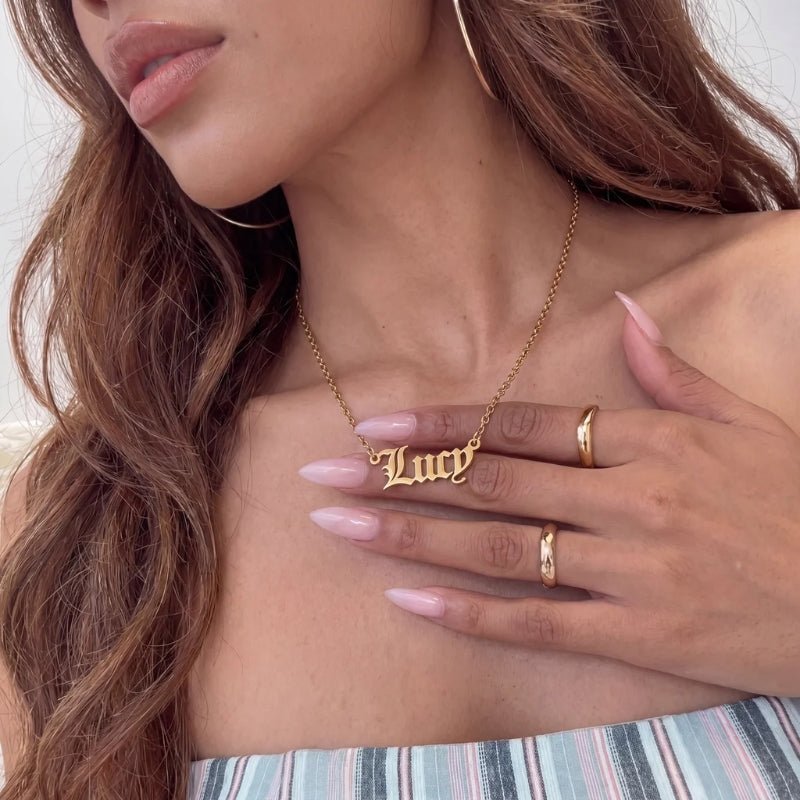
Old English Name Plate Necklace
The bold, uncompromising nameplate. The original. The Old English Name Plate Necklace carries this heritage forward. The blackletter font nods directly to the ornate calligraphy of 1980s New York gold, while the 18k gold-plated stainless steel construction updates it for modern durability. This is the piece that honours the culture that started everything.


The Late 1990s: Carrie Made It Mainstream
For all its cultural significance, the name necklace remained largely a subcultural accessory through the early and mid-1990s. Then, in 1998, a fictional fashion columnist appeared on screen wearing a gold script necklace spelling "Carrie", and everything changed.
The television series Sex and the City did not invent the name necklace, but it did something equally powerful: it introduced it to a global mainstream audience who had never seen one before. The character of Carrie Bradshaw, styled by the legendary Patricia Field, wore her gold name necklace as a signature accessory across multiple seasons. The necklace became inseparable from the character, a symbol of her identity, her independence, and her refusal to be defined by anyone but herself.
What made the necklace culturally significant was its meaning within the show. Carrie's necklace was not a gift from a lover or a family heirloom. It was something she wore for herself, bearing her own name, as an act of self-declaration. In a series that explored women's relationships with men, money and Manhattan, the name necklace was a quiet reminder: before she was anyone's girlfriend, she was Carrie.

Ella Name Necklace
The flowing script name necklace. The style that defined a generation. The Ella Name Necklace is a direct descendant of the Carrie aesthetic: connected cursive letters, elegant curves, and a romantic quality that looks as good on a Saturday in London as it did on a fictional Tuesday in Manhattan. It is the necklace that started the mainstream trend, refined for 2026.


The 2000s: The Celebrity Boom
After Sex and the City, the floodgates opened. Name necklaces moved from a TV prop to a genuine fashion phenomenon throughout the early 2000s. Celebrities began wearing them publicly: Jennifer Lopez, Beyonce, Jessica Simpson and Paris Hilton were all photographed in personalised gold necklaces, each bringing their own interpretation. The personalisation became the point. In an era of mass-produced fast fashion, a name necklace was the one piece that could not be replicated on anyone else.
The 2000s also saw the democratisation of the name necklace. Advances in manufacturing, particularly laser cutting and gold plating, made personalised pieces accessible at lower price points. What had once required a visit to a specialist jeweller could now be ordered online and delivered to your door.
Stylistically, the 2000s favoured larger, bolder designs with thicker chains and bigger letters. The nameplate sat lower on the chest, designed to be visible from across the room. This era's aesthetic was unambiguous: the name necklace was meant to be seen.

Custom Tennis Name Necklace
Bold, visible, unapologetic. The Custom Tennis Name Necklace channels the energy of the celebrity era. Your name set in individual letters, each one encrusted with clear cubic zirconia that sparkles under any lighting. It carries the confidence of the 2000s with modern waterproof construction. This is the name necklace for the woman who wants to be noticed.


The 2010s: Minimalism and the Instagram Effect
The pendulum swung. By the mid-2010s, fashion had moved towards clean lines, neutral palettes, and the aesthetic that would eventually be called "quiet luxury." Name necklaces did not disappear, but they evolved. The bold, in-your-face nameplates of the 2000s gave way to smaller, more delicate pieces. Thin chains. Smaller letters. Names that sat closer to the collarbone, meant to be discovered rather than announced.
Instagram accelerated this shift. The platform rewarded detail: close-up shots of layered necklaces, flat-lays of gold chains against bare skin, the aesthetic of curated minimalism. Name necklaces became part of a "necklace stack" rather than a standalone statement. Women began wearing them in multiples: a name necklace, a zodiac pendant, a birthstone chain, all layered at different lengths.
This era also popularised the vertical name necklace, a design where the name reads top-to-bottom rather than left-to-right. It was sleeker, more architectural, and perfectly suited to the minimalist aesthetic of the decade. It was also the first truly "new" name necklace format in decades.

Vertical Signature Necklace
Pure 2010s minimalism brought into the pre/collections/personalised-jewelleryf="/collections/all">Vertical Signature Necklace runs your name vertically, reading as a sleek bar pendant from a distance and revealing itself only up close. It is the name necklace for the woman who wants personalisation without performance. Identity without exhibition.


The 2020s: Everything at Once
And then we arrived here. The 2020s collapsed the hierarchy. There is no single dominant style, there is every style simultaneously. The Old English nameplate exists alongside the minimalist vertical pendant alongside the playful bubble letter alongside the classic script. The fashion ecosystem of the 2020s is one of radical personal choice: wear what you want, how you want, with whatever meaning you assign to it.
Several forces converged to create this moment. TikTok accelerated trend cycles to the point where "vintage" styles from the 1980s and 1990s circulate alongside brand new designs. The personalisation economy exploded post-pandemic, as consumers sought meaningful, one-of-a-kind products in reaction to years of mass consumption. And the name necklace, which had always been about identity, became even more resonant in a decade defined by conversations about identity itself.
The 2020s also brought a new format: the deconstructed name necklace, where individual letters hang separately from the chain rather than being connected as a single nameplate. It reflected a broader cultural move towards individuality, space, and the idea that identity is not a single fixed word but a collection of parts that move together.

Dangling Letters Necklace
The purest expression of 2020s name necklace culture. Each letter of the Dangling Letters Necklace hangs independently, moving freely, spelling your name without being locked into a single rigid form. It is the most modern interpretation of the name necklace: identity as something fluid, chosen and beautifully assembled.


2026: The Year of the Bubble
If the 2020s are "everything at once," 2026 has a clear frontrunner: the bubble font. Social media has driven a resurgence of playful, Y2K-adjacent aesthetics. Chunky sneakers, oversized sunglasses, jelly bags, and now, 3D bubble-letter jewellery. The bubble name necklace has become the defining accessory of the year: bold, joyful, impossible to ignore, and entirely at odds with the quiet luxury that dominated the early part of the decade.
The appeal is partly nostalgia (bubble letters were the handwriting of choice in every 2000s school notebook), partly rebellion (after years of minimalism, maximalism feels radical), and partly practical. The 3D bubble form makes each letter larger and more sculptural, which means it photographs exceptionally well. In a world where every purchase is also content, the bubble name necklace is made for the camera.

Bubble Letter Necklace
The undisputed name necklace of the moment. The Bubble Letter Necklace features rounded, three-dimensional letter charms studded with clear zirconia that catch every light source. Bold and proud against the chest, it is the most fun name necklace in the personalised collection. Playful, sparkly, and entirely at odds with quiet luxury. This is the necklace that will date your photos to exactly this year, in the best possible way.


The Full Timeline
| Era | Cultural Moment | Defining Style |
|---|---|---|
| 1980s | NYC hip-hop, bold identity, subcultural pride | Old English Name Plate |
| Late 1990s | Carrie Bradshaw, global mainstream boom | Ella Name Necklace |
| 2000s | Celebrity era, sparkle and scale | Custom Tennis Name Necklace |
| 2010s | Instag/collections/personalised-jewelleryquiet luxury, layering | Vertical Signature Necklace |
| 2020s | Deconstruction, radical personal choice | Dangling Letters Necklace |
| 2026 | Bubble, Y2K revival, joyful maximalism | Bubble Letter Necklace |
Why the Name Necklace Will Never Die
Most jewellery trends have a lifespan. They emerge, they peak, they become dated, and they disappear into the back of a drawer. The name necklace has defied this cycle for nearly half a century, and there is a simple reason why: it is not really about fashion. It is about identity. For styling inspiration, see our name necklace styling guide.
Fashion changes. Your name does not. The desire to be seen, recognised and remembered does not. The impulse to wear something that is uniquely, unmistakably yours does not. The name necklace survives because it taps into something deeper than trend. It taps into the human need to say "I exist, and this is who I am."


Every decade reinterprets the form. The 1980s made it bold. The late 1990s made it glamorous. The 2000s made it sparkle. The 2010s made it subtle. The 2020s made it fluid. And 2026 made it fun. But the core has not changed since a jeweller in the Bronx first bent a piece of gold into someone's name and hung it on a chain: this is me. Worn proudly, worn daily, worn always.
The name necklace survives because it taps into something deeper than trend. It taps into the human need to say "I exist, and this is who I am."
Frequently Asked Questions
Who started the name necklace trend?
Name necklaces originated in Black and Latino communities in New York City during the late 1970s and early 1980s. Gold nameplates became a symbol of identity and pride within hip-hop culture, long before they entered the mainstream through television and celebrity endorsement.
Did Carrie Bradshaw make name necklaces famous?
Carrie Bradshaw's character in Sex and the City popularised name necklaces for a global mainstream audience from 1998 onwards. However, name necklaces had existed as a significant cultural accessory for nearly two decades before the show aired. The show introduced the style to people who had not encountered it before.
What is the most popular name necklace style in 2026?
The bubble letter style is the defining trend of 2026, driven by Y2K nostalgia and social media. However, the beauty of the current moment is that every style from every decade works simultaneously. Classic script, Old English, tennis-style, vertical and deconstructed designs are all popular.
Are name necklaces still in style?
Name necklaces have never gone out of style. Each decade reinterprets the format, but the core appeal, wearing your own name as a personal statement, is timeless. They are currently experiencing one of their biggest surges in popularity thanks to TikTok and the personalisation trend. Browse our best personalised name necklaces for current picks.
How much does a name necklace cost in the UK?
Modern name necklaces in waterproof PVD-coated gold start from around 34 pounds. Solid gold pieces from specialist jewellers can cost 500 pounds or more depending on carat weight and name length. The quality of the base metal is the biggest price factor, not the style.
What is the difference between a nameplate and a name necklace?
A nameplate specifically refers to the bold, capitalised style that originated in 1980s New York, typically in block or Old English lettering. "Name necklace" is the broader term covering all styles: script, vertical, tennis-style, deconstructed and bubble. All nameplates are name necklaces, but not all name necklaces are nameplates.
Can I wear a name necklace every day?
Yes, if the construction allows it. Pieces made from PVD-coated stainless steel are waterproof, sweatproof, and tarnish-resistant, meaning you can shower, exercise and sleep in them without damage. Standard gold-plated pieces require more care. Look for a lifetime colour warranty as the strongest indicator of daily-wear durability.
Your Name in Gold.
The name necklace has survived every trend, every decade and every shift in fashion. Because your name never goes out of style. Waterproof, personalised and backed by a lifetime colour warranty. Choose your era.
Shop All Name Necklaces


